PDF Ebook Sleeping Giants (The Themis Files), by Sylvain Neuvel
On top of that, we will certainly discuss you guide Sleeping Giants (The Themis Files), By Sylvain Neuvel in soft file forms. It will certainly not disrupt you making heavy of you bag. You require only computer system device or device. The link that we provide in this site is offered to click and after that download this Sleeping Giants (The Themis Files), By Sylvain Neuvel You recognize, having soft documents of a book Sleeping Giants (The Themis Files), By Sylvain Neuvel to be in your device can make ease the viewers. So by doing this, be a good visitor currently!
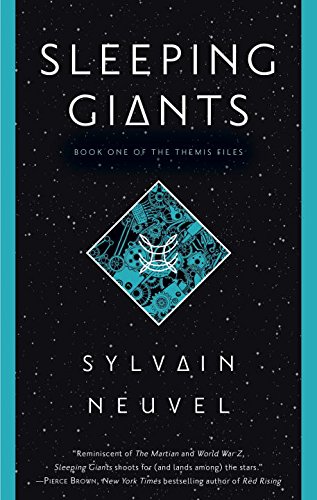
Sleeping Giants (The Themis Files), by Sylvain Neuvel

PDF Ebook Sleeping Giants (The Themis Files), by Sylvain Neuvel
Exactly how if there is a site that allows you to hunt for referred book Sleeping Giants (The Themis Files), By Sylvain Neuvel from all over the globe publisher? Immediately, the website will be extraordinary completed. So many book collections can be located. All will be so simple without challenging point to relocate from site to website to get the book Sleeping Giants (The Themis Files), By Sylvain Neuvel really wanted. This is the website that will offer you those expectations. By following this site you could get lots varieties of book Sleeping Giants (The Themis Files), By Sylvain Neuvel collections from variations types of writer as well as author popular in this world. The book such as Sleeping Giants (The Themis Files), By Sylvain Neuvel and others can be gotten by clicking good on web link download.
As recognized, lots of people say that e-books are the custom windows for the world. It doesn't indicate that getting publication Sleeping Giants (The Themis Files), By Sylvain Neuvel will mean that you can buy this world. Merely for joke! Reading a book Sleeping Giants (The Themis Files), By Sylvain Neuvel will opened a person to believe much better, to maintain smile, to captivate themselves, and to urge the expertise. Every publication likewise has their unique to influence the viewers. Have you understood why you review this Sleeping Giants (The Themis Files), By Sylvain Neuvel for?
Well, still confused of how you can get this e-book Sleeping Giants (The Themis Files), By Sylvain Neuvel right here without going outside? Just link your computer system or gadget to the web and begin downloading and install Sleeping Giants (The Themis Files), By Sylvain Neuvel Where? This page will certainly show you the link page to download Sleeping Giants (The Themis Files), By Sylvain Neuvel You never worry, your favourite publication will be earlier your own now. It will be considerably less complicated to delight in reading Sleeping Giants (The Themis Files), By Sylvain Neuvel by online or obtaining the soft file on your kitchen appliance. It will certainly despite which you are as well as exactly what you are. This book Sleeping Giants (The Themis Files), By Sylvain Neuvel is written for public and also you are just one of them which could appreciate reading of this e-book Sleeping Giants (The Themis Files), By Sylvain Neuvel
Investing the extra time by reviewing Sleeping Giants (The Themis Files), By Sylvain Neuvel could offer such terrific experience even you are simply seating on your chair in the workplace or in your bed. It will not curse your time. This Sleeping Giants (The Themis Files), By Sylvain Neuvel will certainly guide you to have even more valuable time while taking remainder. It is extremely enjoyable when at the twelve noon, with a cup of coffee or tea as well as an e-book Sleeping Giants (The Themis Files), By Sylvain Neuvel in your kitchen appliance or computer monitor. By enjoying the views around, here you can begin reading.
A page-turning debut in the tradition of Michael Crichton, World War Z, and The Martian, Sleeping Giants is a thriller fueled by an earthshaking mystery—and a fight to control a gargantuan power.
�
A girl named Rose is riding her new bike near her home in Deadwood, South Dakota, when she falls through the earth. She wakes up at the bottom of a square hole, its walls glowing with intricate carvings. But the firemen who come to save her peer down upon something even stranger: a little girl in the palm of a giant metal hand.
�
Seventeen years later, the mystery of the bizarre artifact remains unsolved—its origins, architects, and purpose unknown. Its carbon dating defies belief; military reports are redacted; theories are floated, then rejected.
�
But some can never stop searching for answers.
�
Rose Franklin is now a highly trained physicist leading a top secret team to crack the hand’s code. And along with her colleagues, she is being interviewed by a nameless interrogator whose power and purview are as enigmatic as the provenance of the relic. What’s clear is that Rose and her compatriots are on the edge of unraveling history’s most perplexing discovery—and figuring out what it portends for humanity. But once the pieces of the puzzle are in place, will the result prove to be an instrument of lasting peace or a weapon of mass destruction?
�
Praise for Sleeping Giants
“Reminiscent of The Martian and World War Z, Sleeping Giants is a luminous conspiracy yarn that shoots for (and lands among) the stars.”—Pierce Brown, New York Times bestselling author of Red Rising
�
“As high-concept as it is, Sleeping Giants is a thriller through and through. . . . Not only is Sleeping Giants one of the most promising series kickoffs in recent memory, it’s a smart demonstration of how science fiction can honor its traditions and reverse-engineer them at the same time.”—NPR
�
“Neuvel�weaves a complex tapestry with ancient machinery buried in the Earth, shadow governments, and geopolitical conflicts. But�the most surprising thing about the book may just be how compelling the central characters are in the midst of these larger-than-life concepts. . . . I can’t stop thinking about it.”—Chicago Review of Books
“First-time novelist Sylvain Neuvel does a bold, splashy cannonball off the high dive with Sleeping Giants. It bursts at the seams with big ideas and the questions they spawn—How much human life is worth sacrificing in the pursuit of scientific progress? Can humanity be trusted with weapons of ultimate destruction? And the biggest: Are we alone? But all that really matters is that this book is a sheer blast from start to finish. I haven’t had this much fun reading in ages.”—Blake Crouch, author of Dark Matter and the bestselling Wayward Pines trilogy
“A remarkable debut . . . Reminiscent of Max Brooks’s World War Z, the story’s format effectively builds suspense.”—Library Journal (debut of the month)
�
“This stellar debut novel . . . masterfully blends together elements of sci-fi, political thriller and apocalyptic fiction. . . . A page-turner of the highest order.”—Kirkus Reviews (starred review)
“[A] fascinating first novel . . . This intriguing tale is entirely worthy of an adult audience.”—Publishers Weekly
From the Hardcover edition.
- Sales Rank: #9397 in Books
- Brand: DEL REY
- Published on: 2017-01-24
- Released on: 2017-01-24
- Original language: English
- Number of items: 1
- Dimensions: 8.30" h x .70" w x 5.50" l,
- Binding: Paperback
- 336 pages
- DEL REY
Review
“Reminiscent of The Martian and World War Z, Sleeping Giants is a luminous conspiracy yarn that shoots for (and lands among) the stars.”—Pierce Brown, New York Times bestselling author of Red Rising
�
“As high-concept as it is, Sleeping Giants is a thriller through and through. . . . Not only is Sleeping Giants one of the most promising series kickoffs in recent memory, it’s a smart demonstration of how science fiction can honor its traditions and reverse-engineer them at the same time.”—NPR
�
“[Sylvain] Neuvel�weaves a complex tapestry with ancient machinery buried in the Earth, shadow governments, and geopolitical conflicts. But�the most surprising thing about the book may just be how compelling the central characters are in the midst of these larger-than-life concepts. . . . I can’t stop thinking about it.”—Chicago Review of Books
“First-time novelist Sylvain Neuvel does a bold, splashy cannonball off the high dive with Sleeping Giants. It bursts at the seams with big ideas and the questions they spawn—How much human life is worth sacrificing in the pursuit of scientific progress? Can humanity be trusted with weapons of ultimate destruction? And the biggest: Are we alone? But all that really matters is that this book is a sheer blast from start to finish. I haven’t had this much fun reading in ages.”—Blake Crouch, author of Dark Matter and the bestselling Wayward Pines trilogy
“A remarkable debut . . . Reminiscent of Max Brooks’s World War Z, the story’s format effectively builds suspense.”—Library Journal (debut of the month)
�
“This stellar debut novel . . . masterfully blends together elements of sci-fi, political thriller and apocalyptic fiction. . . . A page-turner of the highest order.”—Kirkus Reviews (starred review)
“[A] fascinating first novel . . . This intriguing tale is entirely worthy of an adult audience.”—Publishers Weekly
From the Hardcover edition.
About the Author
Sylvain Neuvel is a linguist and translator based in Montreal. He is at work on an R2-D2 replica and his next novel.
From the Hardcover edition.
Excerpt. � Reprinted by permission. All rights reserved.
PART ONE
Body Parts
File No. 003
Interview with Dr. Rose Franklin, Ph.D., Senior Scientist, Enrico Fermi Institute
Location: University of Chicago, Chicago, IL
—How big was the hand?
—6.9 meters, about twenty-three feet; though it seemed much larger for an eleven-year-old.
—What did you do after the incident?
—Nothing. We didn’t talk about it much after that. I went to school every day like any kid my age. No one in my family had ever been to college, so they insisted I keep going to school. I majored in physics.
I know what you’re going to say. I wish I could tell you I went into science because of the hand, but I was always good at it. My parents figured out I had a knack for it early on. I must have been four years old when I got my first science kit for Christmas. One of those electronics kits. You could make a telegraph, or things like that, by squeezing wires into little metal springs. I don’t think I would have done anything different had I listened to my father and stayed home that day.
Anyway, I graduated from college and I kept doing the only thing I knew how to do. I went to school. You should have seen my dad when we learned I was accepted at the University of Chicago. I’ve never seen anyone so proud in my life. He wouldn’t have been any happier had he won a million dollars. They hired me at the U of C after I finished my Ph.D.
—When did you find the hand again?
—I didn’t. I wasn’t looking for it. It took seventeen years, but I guess you could say it found me.
—What happened?
—To the hand? The military took over the site when it was discovered.
—When was that?
—When I fell in. It took about eight hours before the military stepped in. Colonel Hudson—I think that was his name—was put in charge of the project. He was from the area so he knew pretty much everyone. I don’t remember ever meeting him, but those who did had only good things to say about the man.
I read what little was left of his notes—most of it was redacted by the military. In the three years he spent in charge, his main focus had always been figuring out what those carvings meant. The hand itself, which is mostly referred to as “the artifact,” is mentioned in passing only a few times, evidence that whoever built that room must have had a complex enough religious system. I think he had a fairly precise notion of what he wanted this to be.
—What do you think that was?
—I have no idea. Hudson was career military. He wasn’t a physicist. He wasn’t an archaeologist. He had never studied anything resembling anthropology, linguistics, anything that would be remotely useful in this situation. Whatever preconceived notion he had, it must have come from popular culture, watching Indiana Jones or something. Fortunately for him, he had competent people surrounding him. Still, it must have been awkward, being in charge and having no idea what’s going on most of the time.
What’s fascinating is how much effort they put into disproving their own findings. Their first analysis indicated the room was built about three thousand years ago. That made little sense to them, so they tried carbon-dating organic material found on the hand. The tests showed it to be much older, somewhere between five thousand and six thousand years old.
—That was unexpected?
—You could say that. You have to understand that this flies in the face of everything we know about American civilizations. The oldest civilization we’re aware of was located in the Norte Chico region of Peru, and the hand appeared to be about a thousand years older. Even if it weren’t, it’s fairly obvious that no one carried a giant hand from South America all the way to South Dakota, and there were no civilizations as advanced in North America until much, much later.
In the end, Hudson’s team blamed the carbon dating on contamination from surrounding material. After a few years of sporadic research, the site was determined to be twelve hundred years old and classified as a worship temple for some offshoot of Mississippian civilization.
I went through the files a dozen times. There is absolutely nothing, no evidence whatsoever to support that theory, other than the fact that it makes more sense than anything the data would suggest. If I had to guess, I would say that Hudson saw no military interest whatsoever in all this. He probably resented seeing his career slowly wither in an underground research lab and was eager to come up with anything, however preposterous, just to get out of there.
—Did he?
—Get out? Yes. It took a little more than three years, but he finally got his wish. He had a stroke while walking his dog and slipped into a coma. He died a few weeks later.
—What happened to the project after he died?
—Nothing. Nothing happened. The hand and panels collected dust in a warehouse for fourteen years until the project was demilitarized. Then the University of Chicago took over the research with NSA funding and somehow I was put in charge of studying the hand I fell in when I was a child. I don’t really believe in fate, but somehow “small world” doesn’t begin to do this justice.
—Why would the NSA get involved in an archaeological project?
—I asked myself the same question. They fund all kinds of research, but this seems to fall outside their usual fields of interest. Maybe they were interested in the language for cryptology; maybe they had an interest in the material the hand is made of. In any case, they gave us a pretty big budget so I didn’t ask too many questions. I was given a small team to handle the hard science before we handed everything over to the anthropology department. The project was still classified as top secret and, just like my predecessor, I was moved into an underground lab. I believe you’ve read my report, so you know the rest.
—Yes, I have read it. You sent your report after only four months. Some might think it was a little hasty.
—It was a preliminary report, but yes. I don’t think it was premature. OK, maybe a little, but I had made significant discoveries and I didn’t think I could go much further with the data that I had, so why wait? There is enough in that underground room to keep us guessing for several lifetimes. I just don’t think we have the knowledge to get much more out of this without getting more data.
—Who is we?
—Us. Me. You. Mankind. Whatever. There are things in that lab that are just beyond our reach right now.
—Ok, so tell me about what you do understand. Tell me about the panels.
—It’s all in my report. There are sixteen of them, approximately ten feet by thirty-two feet each, less than an inch thick. All sixteen panels were made around the same period, approximately three thousand years ago. We . . .
—If I may. I take it you do not subscribe to the cross-contamination theory?
—As far as I’m concerned, there’s no real reason not to trust the carbon dating. And to be honest, how old these things are is the least of our problems. Did I mention the symbols have been glowing for the last seventeen years, with no apparent power source?
Each wall is made of four panels and has a dozen rows of eighteen to twenty symbols carved into it. Rows are divided into sequences of six or seven symbols. We counted fifteen distinct symbols in total. Most are used several times, some appear only once. Seven of them are curvy, with a dot in the center, seven are made of straight lines, and one is just a dot. They are simple in design but very elegant.
—Had the previous team been able to interpret any of the markings?
—Actually, one of the few sections of Hudson’s report left intact by the military was the linguistic analysis. They had compared the symbols to every known writing system, past or present, but found no interesting correlation. They assumed each sequence of symbols represented a proposition, like an English sentence, but with no frame of reference, they couldn’t even speculate as to their interpretation. Their work was thorough enough and documented at every step. I saw no reason to do the same thing twice and I declined the offer to add a linguist to the team. With nothing to compare this to, there was logically no way to arrive at any sort of meaning.
Perhaps I was biased—because I stumbled onto it—but I felt drawn to the hand. I couldn’t explain it, but every fiber of my being was telling me the hand was the important piece.
—Quite a contrast from your predecessor. So what can you tell me about it?
—Well, it’s absolutely stunning, but I assume you’re not that interested in aesthetics. It measures 22.6 feet in length from the wrist to the tip of the middle finger. It seems to be solid, made of the same metallic material as the wall panels, but it’s at least two thousand years older. It is dark gray, with some bronze overtones, and it has subtle iridescent properties.
The hand is open, fingers close together, slightly bent, as if holding something very precious, or a handful of sand, trying not to spill it. There are grooves where human skin would normally fold, others that seem purely decorative. All are glowing the same bright turquoise, which brings out the iridescence in the metal. The hand looks strong, but . . . sophisticated is the only word that comes to mind. I think it’s a woman’s hand.
—I am more interested in facts at this point. What is this strong but sophisticated hand made of?
—It proved nearly impossible to cut or otherwise alter by conventional means. It took several attempts to remove even a small sample from one of the wall panels. Mass spectrography showed it to be an alloy of several heavy metals, mostly iridium, with about 10 percent iron and smaller concentrations of osmium, ruthenium, and other metals of the platinum group.
—It must be worth its weight in gold?
—It’s funny you should mention that. It doesn’t weigh as much as it should so I’d say it’s worth a lot more than its weight, in anything.
—How much does it weigh?
—Thirty-two metric tons . . . I know, it’s a respectable weight, but it’s inexplicably light given its composition. Iridium is one of the densest elements, arguably the densest, and even with some iron content, the hand should easily weigh ten times as much.
—How did you account for that?
—I didn’t. I still can’t. I couldn’t even speculate as to what type of process could be used to achieve this. In truth, the weight didn’t bother me nearly as much as the sheer amount of iridium I was looking at. Iridium is not only one of the densest things you can find, it’s also one of the rarest.
You see, metals of this group—platinum is one of them—love to bond with iron. That’s what most of the iridium on Earth did millions of years ago when the surface was still molten and, because it’s so heavy, it sunk to the core, thousands of miles deep. What little is left in the Earth’s crust is usually mixed with other metals and it takes a complex chemical process to separate them.
—How rare is it in comparison to other metals?
—It’s rare, very rare. Let’s put it this way, if you were to put together all the pure iridium produced on the entire planet in a year, you’d probably end up with no more than a couple metric tons. That’s about a large suitcaseful. It would take decades, using today’s technology, to scrounge up enough to build all this. It’s just too scarce on Earth and there simply aren’t enough chondrites lying around.
—You lost me.
—Sorry. Meteorites; stony ones. Iridium is so rare in Earth rocks that it is often undetectable. Most of the iridium we mine is extracted from fallen meteorites that didn’t completely burn up in the atmosphere. To build this room—and it seems safe to assume that this is not the only thing they would have built—you’d need to find it where there are a lot more than on the Earth’s surface.
—Journey to the center of the Earth?
—Jules Verne is one way to go. To get this type of metal in massive quantities, you’d either have to extract it thousands of miles deep or be able to mine in space. With all due respect to Mr. Verne, we haven’t come close to mining deep enough. The deepest mines we have would look like potholes next to what you’d need. Space seems much more feasible. There are private companies right now hoping to harvest water and precious minerals in space in the very near future, but all these projects are still in the early planning stages. Nonetheless, if you could harvest meteorites in space, you could get a lot more iridium, a whole lot more.
—What else can you tell me?
—That pretty much sums it up. After a few months of looking at this with every piece of equipment known to man, I felt we were getting nowhere. I knew we were asking the wrong questions, but I didn’t know the right ones. I submitted a preliminary report and asked for a leave of absence.
—Refresh my memory. What was the conclusion of that report?
—We didn’t build this.
—Interesting. What was their reaction?
—Request granted.
—That was it?
—Yes. I think they were hoping I wouldn’t come back. I never used the word “alien,” but that’s probably all they took out of my report.
—That is not what you meant?
—Not exactly. There might be a much more down-to-earth explanation, one I just didn’t think of. As a scientist, all I can say is that humans of today do not have the resources, the knowledge, or the technology to build something like this. It’s entirely possible that some ancient civilization’s understanding of metallurgy was better than ours, but there wouldn’t have been any more iridium around, whether it was five thousand, ten thousand, or twenty thousand years ago. So, to answer your question, no, I don’t believe humans built these things. You can draw whatever conclusion you want from that.
I’m not stupid; I knew I was probably putting an end to my career. I certainly annihilated any credibility I had with the NSA, but what was I going to do? Lie?
—What did you do after you submitted your report?
—I went home, to where it all began. I hadn’t gone home in nearly four years, not since my father died.
—Where is home?
Most helpful customer reviews
42 of 45 people found the following review helpful.
Surprisingly good
By Javier Ruiz
This is my first book review, but I thought I'd give it a try.
I decided to look into this book when I heard that it had already been picked up to be made into a movie. I was intrigued. I am not a fan of this narrative style where the story is told as a series of interviews or documents, like it was with World War Z, but still, I was curious about this book. I have to say, I really enjoyed it. However, let me qualify this statement; I purchased both the eBook as well as the audible version. The audible version is read by an actual cast of several narrators, and is what made the book come to life for me. The few times I read the eBook, I found myself wishing I was able to switch back to the audiobook. That's not too say that the story is bad, but to me this kind of book came to life more easily when performed than on a page. Personal opinion, obviously.
The theme was interesting to me. A new take on the "alien artifact" story, but one that was well executed, in my opinion. And it was also enhanced by the fact that they took into account current geopolitical conditions, and did not recur to tropes such as creating a one-world defense force like the United Federation of Planets so the whole world could benefit and everyone lived happily ever after. At least they haven't done so in this first book. Having the US traipse all over the world with their special teams tracking down pieces of this giant machine put them in a huge heap of trouble, because we do not live in a perfect world. That made it more real to me.
The books ends in a way that wraps the current story neatly, but clearly leaves the door open for any of us who want to know more, and to find out what happens next. I have already preordered the next book in this series.
15 of 15 people found the following review helpful.
Cheesy format results in unreadable story.
By Richard Millward
The story - which starts with at least an interesting premise - is buried under the silly pretense of being "interviews," of key characters by a shadowy "man in charge." This lazy, post-modern take on an epistolary novel smothers the actual story. The device also has the (surely unintended?) effect of highlighting that this author has no ear at all for natural sounding dialogue. Save your money. This one's a real clunker.
10 of 10 people found the following review helpful.
Tiresome
By AbnormalModes
My initial excitement ebbed rapidly once I realized the whole book would epitomize a "tell, don't show". The dialogue is stilted, the exposition endless and leaden, and the characters paper thin at best. Give this a hard pass and go re-read The Martian.
Sleeping Giants (The Themis Files), by Sylvain Neuvel PDF
Sleeping Giants (The Themis Files), by Sylvain Neuvel EPub
Sleeping Giants (The Themis Files), by Sylvain Neuvel Doc
Sleeping Giants (The Themis Files), by Sylvain Neuvel iBooks
Sleeping Giants (The Themis Files), by Sylvain Neuvel rtf
Sleeping Giants (The Themis Files), by Sylvain Neuvel Mobipocket
Sleeping Giants (The Themis Files), by Sylvain Neuvel Kindle


